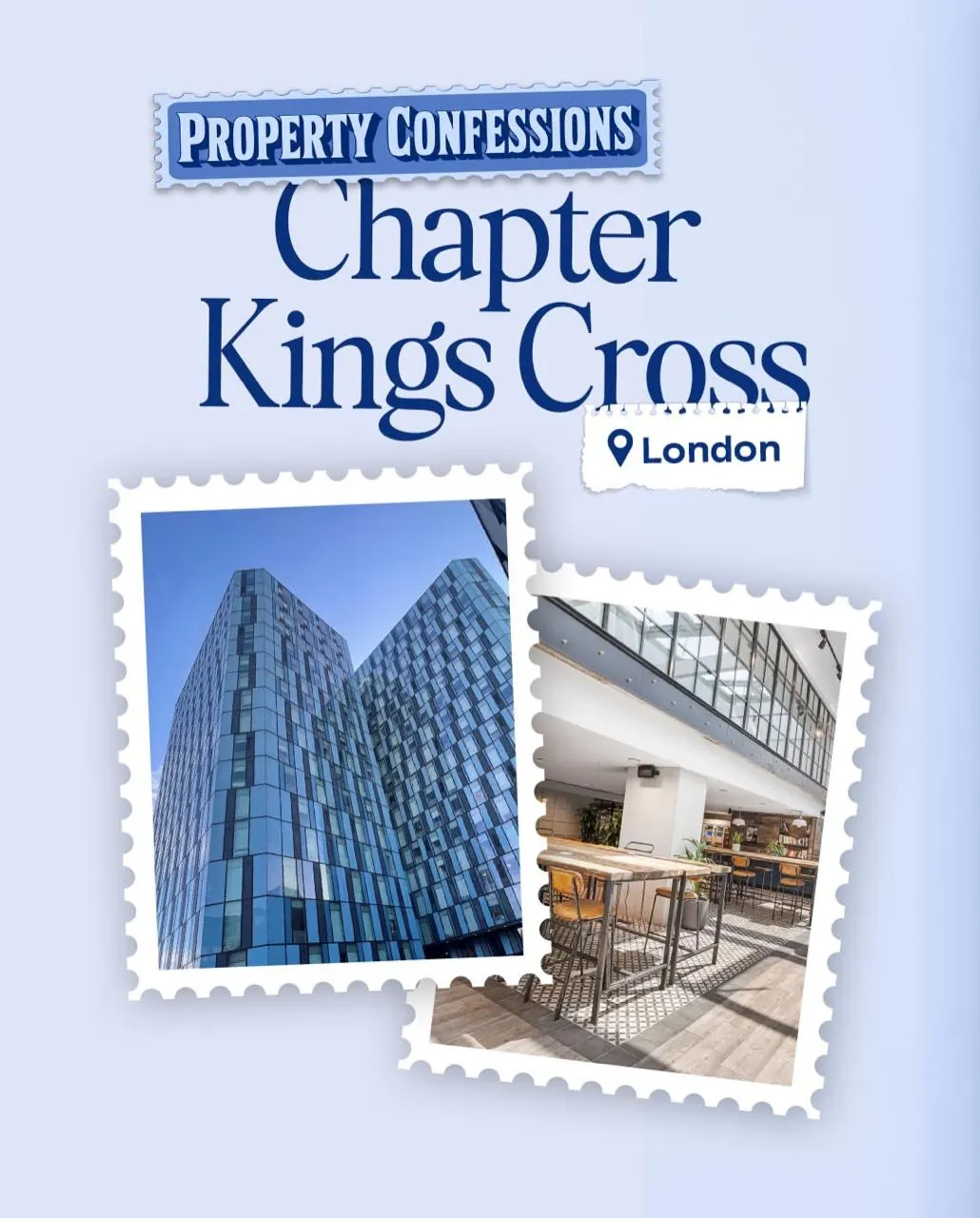
PBSA stands for purpose-built student accommodation: buildings designed for students, with rent that includes bills, on-site staff, and a contract aligned to the academic year. For international students it removes the two hardest parts of UK renting, which are finding a guarantor and furnishing a flat from scratch.
Two things are different this year, and both work in your favour. Rooms are no longer scarce in most cities, and the law changed on 1 May 2026 in a way that makes the PBSA contract and the private-house contract behave very differently. Both are covered below.
What is PBSA?
PBSA is student housing built specifically for students rather than converted from ordinary residential stock. A room comes furnished, rent covers electricity, water, heating and internet in a single payment, and the building has on-site management.
The practical distinctions from a private flat or shared house:
- Rent is all-inclusive, so you have one payment rather than five accounts to set up
- Most operators accept international students without a UK guarantor, sometimes in exchange for a larger advance payment
- Contracts run 43 to 51 weeks, matched to the academic year
- Buildings are managed, with maintenance, security and a staffed reception
What PBSA actually costs
Below is sourced data rather than an estimate. Note the survey dates, because rents have moved since.
| Market | Average annual rent | Source and date |
| London PBSA | £13,595 | Unipol/HEPI London Rent Survey, 2024 |
| 10 regional cities, average | £7,475 | Unipol/HEPI Accommodation Costs Survey, 2023/24 |
| Bristol (most expensive regional) | £9,200 | Unipol/HEPI, 2023/24 |
| Exeter | £8,559 | Unipol/HEPI, 2023/24 |
| Leeds | £7,627 | Unipol/HEPI, 2023/24 |
| Glasgow | £7,548 | Unipol/HEPI, 2023/24 |
| Liverpool, Cardiff, Sheffield | £6,400 to £6,600 | Unipol/HEPI, 2023/24 |
Two things this table tells you that a weekly range does not:
Contracts are usually 44 to 51 weeks, so the annual figure is the real figure. A £150 per week room on a 51-week contract is £7,650, and you pay for the summer whether you are there or not. Compare annual totals, not weekly headline rates.
The affordable cities are the well-supplied ones. Liverpool, Cardiff and Sheffield sit at the bottom of that table because they have enough beds. Bristol and Exeter sit at the top because they do not. Supply, not prestige, drives the price.
For context on affordability: the London maintenance loan for home students is around £14,135, against an average London PBSA rent of £13,595. That gap is why the sector has been described as being at a crisis point by both Unipol and HEPI.
What changed on 1 May 2026: the Renters' Rights Act
This is the most important section on the page, and it is the one competitors have not updated.
The Renters' Rights Act 2025 abolished fixed-term assured shorthold tenancies in England. Most private lets are now rolling assured periodic tenancies, and tenants can leave on two months' notice. Section 21 evictions are gone.
PBSA is exempt, but only conditionally. An operator can keep offering fixed-term, academic-year contracts only if it is a member of an approved code of practice, such as the ANUK/Unipol Code of Standards for Larger Developments. Where a provider is not code-accredited, its lettings fall under the periodic tenancy regime instead. The exemption is not retrospective, so PBSA tenancies granted before 1 May 2026 converted to periodic tenancies.
What this means for you as a student:
| * | Code-accredited PBSA | Private student house (HMO) |
| Contract | Fixed term, academic year | Rolling periodic tenancy |
| Can you leave early? | Only under the contract's release or replacement clause | Yes, two months' notice |
| Rent in advance | Provider can require it | Restricted under the Act |
| Certainty of dates | High, dates are fixed | Landlord relies on statutory grounds to recover the property in summer |
Read that table carefully, because the honest reading is not "PBSA wins". A rolling tenancy gives you an exit route that a fixed-term PBSA contract does not. If there is any chance your plans change mid-year, that flexibility has real value. If you want certainty that your room is yours until your course ends, the fixed term is worth more.
The practical takeaway: before you sign anything, check whether the operator is a member of an approved code. It now tells you what kind of contract you are actually getting, and it is a meaningful quality signal about the building's management standards. It is a better vetting question than asking whether there is CCTV.
Should you book early? The answer changed
For several years the correct advice was to book as early as possible. That is no longer clearly true.
Private PBSA occupancy for 2025/26 came in at 85.4%, down 5.4% on the year before, against a pre-pandemic operating norm of 95% to 98%. Shortages have largely abated. Operators have responded with incentives and, in some markets, year-on-year rent reductions. Lettings for 2026/27 were tracking slightly behind the previous cycle as of late 2025.
Students noticed before the guides did. Many are deliberately booking later, because incentives appear later.
So the honest position is a trade-off rather than a rule:
Book early if you need a specific building, a studio, a dual-occupancy room, an accessible room, or accommodation in a genuinely tight market. Scarce room types still go first, and the cheapest rooms in any building always go first regardless of overall occupancy.
Wait if you are flexible on building and room type in a well-supplied city, and you can tolerate the uncertainty. Incentives, discounts and rent-match offers tend to surface as operators approach the start of term with unlet rooms.
Do not wait if your visa timeline requires a confirmed address, or if your university offer is conditional on securing accommodation. Certainty is worth paying for in that situation.
One caution: this is a national picture, and individual cities diverge sharply. A city with new supply coming online behaves very differently from one with a stalled pipeline. Ask the provider directly how many rooms of your type are still available. In this market they will usually tell you.
Room types
| Type | What you get | Suits |
| Ensuite | Private bedroom and bathroom, shared kitchen | Most students; the default choice |
| Studio | Private room, bathroom and kitchenette | Anyone who wants full independence, at the highest price |
| Cluster flat | Private bedroom, shared kitchen and lounge with 4 to 8 others | Students who want a built-in social group |
| Twin or shared | Two students to a bedroom | The cheapest option, and the one most often sold out first |
| Dual occupancy studio | Studio for two, usually couples | Limited availability, premium buildings |
Studios are typically 40% to 60% more than an ensuite in the same building. If budget is the constraint, an ensuite in a good location beats a studio in a bad one.
PBSA compared with a private shared house
The current version of this page said PBSA "wins easily". That is not accurate enough to be useful.
Where PBSA is genuinely better: no guarantor requirement, no utility accounts to set up, no deposit disputes with an individual landlord, on-site maintenance, and a contract that ends when your course year ends.
Where a private house is genuinely better: it is usually cheaper per person once you are in a group of four or more, you get a full kitchen and living space rather than a kitchenette, and since May 2026 you can leave on two months' notice. Private houses also tend to be larger. PBSA rooms in newer buildings can be small.
Where PBSA suits you specifically: first year, arriving from overseas, no UK contacts to form a house group with, no guarantor, and no appetite for managing bills in a new country. That describes most international first-years, which is why PBSA is the standard recommendation for them. It does not make it the standard recommendation for a returning second-year with three friends and a year of UK experience.
Booking: what the process looks like
- Shortlist by commute, not by facilities. A cinema room you will use twice matters less than a 12-minute walk you make twice a day. Check the actual walking route, not the straight-line distance.
- Compare annual totals. Weekly rate times contract weeks. A shorter contract at a higher weekly rate is often cheaper overall.
- Check code accreditation. See the section above. This determines your contract type.
- Ask what is still available in your room type. In the current market this is a fair question and the answer tells you how much time you have.
- Read the cancellation clause before anything else. See the next section.
- Prepare documents: passport, university offer letter, and for some providers proof of funds or an advance payment in place of a guarantor.
- Pay and sign. Booking fees commonly run £100 to £250, though some operators have dropped or refunded these as an incentive. Ask whether yours is waivable.
- Move in. Complete the inventory check and photograph everything, including existing damage. This is how deposit disputes are avoided.
The clause international students should read first: visa refusal
If your visa is refused or your university offer is withdrawn, can you cancel without penalty?
Most reputable operators offer a no-penalty release in those circumstances, but the terms vary in ways that matter:
- What counts as proof. Usually the official refusal letter or a withdrawal notice from the university. A screenshot is generally not enough.
- What happens to money already paid. Some refund the booking fee, some keep it, some refund rent paid in advance but not the fee.
- The deadline. Some clauses only apply if you notify within a set window of the refusal.
- Deferral instead of cancellation. Some operators will roll your booking to the next intake, which can be better than a refund.
Ask for this clause in writing before you pay anything. If a provider is vague about it, that tells you something. This single question is the highest-value thing an international student can do during the booking process, and it takes one email.
How to judge whether a building is any good
Skip the amenity list. These are the things that predict whether you will be happy there:
- Approved code membership. Covered above. It affects both your contract and the management standard.
- Actual walking time to your department, checked on a map, at your building's specific address.
- Recent reviews mentioning maintenance response times. Every building has a gym. Not every building fixes a broken shower in 48 hours.
- Whether the room has a window that opens and what it faces. Ask for photographs of the specific room type, not the marketing render.
- What the kitchen-to-student ratio is in a cluster flat. Eight people to one kitchen is a different life from four.
- Laundry provision. Two machines for 200 students is a recurring, genuine irritation.
Providers operating in the UK
The larger operators include Unite Students, iQ Student Accommodation, Student Roost, Chapter, Canvas, Vita Student, Host, Homes for Students, Downing Students, Fresh, and Campus Living Villages.
Worth knowing: this sector has consolidated heavily. Student Roost has been owned by a Greystar and GIC joint venture since December 2022 and continues to trade under its own name, and Greystar also runs the Chapter and Canvas brands. Brand names have generally survived the ownership changes, so the name on the building is still the name you deal with, but do not assume two differently branded buildings are run by different companies.
Read Also: London PBSA vs Other Student Accommodation
FAQs
What does PBSA stand for?
Purpose-built student accommodation. It means housing designed and built specifically for students, with all-inclusive rent, on-site management, and contracts aligned to the academic year, rather than ordinary residential property let to students.
How much does PBSA cost in the UK?
Unipol and HEPI recorded an average of £7,475 a year across ten regional cities and £13,595 a year in London. Liverpool, Cardiff and Sheffield are among the cheapest at £6,400 to £6,600. Contracts usually run 44 to 51 weeks, so compare annual totals.
Do I need a UK guarantor for PBSA?
Usually not. Most PBSA operators accept international students without a UK guarantor, though some require a larger payment in advance instead. This is one of the main practical reasons international students choose PBSA over a private tenancy.
Should I book PBSA early for 2026/27?
Not necessarily. Occupancy fell to 85.4% in 2025/26 and operators are offering incentives to fill rooms, so waiting can save money if you are flexible. Book early if you need a studio, an accessible room, a specific building, or a confirmed address for your visa.
Can I cancel if my visa is refused?
Most providers allow a no-penalty release on production of an official refusal letter, but the terms differ on booking-fee refunds and notification deadlines. Get the exact clause in writing before you pay anything.
Is PBSA better than a private house?
It depends on your situation. PBSA is better for international first-years with no guarantor and no house group. A private shared house is usually cheaper for groups of four or more and, since May 2026, lets you leave on two months' notice.
What is the ANUK/Unipol Code and why does it matter now?
It is an approved code of standards for student accommodation. Since 1 May 2026 it determines whether a PBSA operator can still offer fixed-term academic-year contracts under the Renters' Rights Act exemption, so it affects the contract you sign as well as the management standard.
Read Also: PBSA vs Private Rentals for Students: Key Differences